AAPL 182.63 +1.23 (0.68%)
MSFT 407.54 -2.15 (0.53%)
GOOGL 156.78 +0.87 (0.56%)
AMZN 178.75 -1.32 (0.73%)
TSLA 172.63 +3.45 (2.04%)
META 465.98 +2.67 (0.58%)
NVDA 903.56 -12.34 (1.35%)

August 2026

Share Market Courses in Panchkula

Share Market Courses in Panchkula: How to Choose the Right Course for You

Learning about the stock market has become increasingly popular among students, working professionals, aspiring traders, and investors. However, entering the market without proper knowledge can lead to poor decisions and unnecessary risks. A structured course can help learners understand market concepts, analysis techniques, trading strategies, and risk management in a systematic way. With several Share Market Courses in Panchkula available today, choosing the right one can sometimes feel confusing. The best course for you depends on your current knowledge, learning objectives, preferred style of trading, and the level of practical exposure you want. Why Should You Learn the Share Market? The stock market offers opportunities for both investing and trading, but success requires more than simply knowing how to buy or sell a stock. Beginners need to understand market movements, financial instruments, charts, risk management, and decision-making. A structured learning program can help you build these fundamentals before you start making independent market decisions. It can also help you distinguish between short-term trading and long-term investing and understand which approach may suit your personal goals. Types of Share Market Courses in Panchkula Different learners have different objectives. Before enrolling, it is important to understand the major types of courses available. 1. Beginner Stock Market Courses These courses are suitable for people who have little or no prior market knowledge. They generally introduce basic concepts such as stocks, indices, exchanges, demat accounts, market orders, and investment terminology. A beginner-friendly course should explain concepts clearly instead of assuming that students already understand financial markets. 2. Technical Analysis Courses Technical analysis focuses on studying price movements and charts to identify potential market patterns and trends. Learners may explore concepts such as candlestick patterns, support and resistance, indicators, chart patterns, and trend analysis. These courses can be particularly useful for people interested in developing trading strategies. 3. Fundamental Analysis Courses Fundamental analysis focuses on understanding a company’s financial and business performance. Learners may study financial statements, profitability, valuations, industry trends, and other factors that can influence a company’s long-term prospects. This approach is generally more relevant to learners interested in research and long-term investing. 4. Trading-Focused Courses People interested in short-term market participation may consider trading-oriented programs. These may cover intraday trading, swing trading, derivatives, trading psychology, and risk management. However, learners should understand that education cannot eliminate market risk. Trading involves the possibility of financial losses, and strategies should always be approached responsibly. How to Choose the Right Course? When comparing Share Market Courses in Panchkula, don’t choose a program only because of its name, duration, or promotional claims. Consider the following factors. Check the Course Syllabus Start by reviewing what the course actually teaches. A comprehensive syllabus should cover relevant fundamentals along with analysis, strategy development, and risk management. If you are a beginner, look for a program that starts with basic concepts before moving into advanced topics. Look for Practical Learning Theoretical knowledge is important, but practical exposure can make learning easier to understand. Look for courses that include chart analysis, market examples, case studies, demonstrations, or other practical learning activities. The goal should be to understand how concepts are applied rather than simply memorizing definitions. Consider the Trainer’s Experience The quality of instruction can have a significant impact on your learning experience. Before enrolling, research the trainer’s background, teaching approach, market knowledge, and student feedback where available. A good trainer should focus on education and realistic expectations rather than promising guaranteed profits. Compare Learning Formats Many institutes provide both online and classroom-based learning. Consider which format works better for your schedule and learning style. Classroom learning may provide direct interaction and discussions, while online learning can offer greater flexibility. Choose the format that allows you to remain consistent with your studies. Understand the Course Duration and Fees Course duration and fees can vary depending on the syllabus, level, practical sessions, and specialization. Instead of selecting a course simply because it is inexpensive, compare what is included in the program. A clear understanding of the curriculum, sessions, learning resources, and support can help you make a more informed decision. Who Can Join a Share Market Course? A share market course isn’t limited to finance professionals. It can be useful for: The right course should match your current knowledge level and future objectives. Common Mistakes to Avoid When searching for Share Market Courses in Panchkula, avoid choosing a program solely based on advertisements or claims of quick profits. The stock market does not provide guaranteed returns, and no course can remove market risk. Also avoid enrolling without checking the syllabus, practical components, trainer credentials, learning format, and overall course structure. Most importantly, don’t assume that completing a course automatically makes someone a successful trader. Continuous learning, disciplined decision-making, research, and risk management remain important. Build Your Market Knowledge Step by Step Choosing among different Share Market Courses in Panchkula becomes easier when you first identify your objective. If you are completely new to the market, start with the fundamentals. If you already understand the basics, you can explore technical analysis, fundamental analysis, trading, or other specialized areas. The ideal learning journey should focus on developing knowledge and decision-making skills rather than chasing quick profits. A well-structured course can provide a foundation, but applying that knowledge responsibly requires continuous practice and learning. Conclusion Finding the right stock market course is an important first step for anyone interested in financial markets. Instead of choosing a course based only on price or promotional promises, evaluate its syllabus, practical exposure, trainers, learning format, and suitability for your goals. Whether you are a beginner, aspiring trader, or long-term investor, taking time to compare Share Market Courses in Panchkula can help you select a learning path that fits your needs and supports a more informed approach to the stock market.

Share Market Courses in Panchkula: How to Choose the Right Course for You Read More »

Trading classes in Chandigarh

5 Questions to Ask Before Joining Trading Classes in Chandigarh

The stock market has become an increasingly popular learning and career option for students, working professionals, and aspiring traders. However, learning trading from the right source is important because the market involves both opportunities and financial risks. With several trading classes in Chandigarh available today, choosing the right one can sometimes feel confusing. Many institutes promote their courses with attractive offers, short-term programs, or claims about trading success. Instead of making a decision based only on advertisements or course fees, it is better to understand what you will actually learn, who will teach you, and whether the training provides practical knowledge. Before enrolling in a trading course, here are five important questions you should ask. 1. What Will I Actually Learn in the Trading Course? The first and most important question is about the course syllabus. A good trading program should provide a structured learning path rather than only introducing basic stock market terminology. Ask the institute for a detailed syllabus and check whether it covers the topics you are interested in learning. A comprehensive program may include stock market fundamentals, technical analysis, fundamental analysis, price action, chart patterns, indicators, intraday trading, swing trading, risk management, and trading psychology. Beginners should ideally start with market basics before moving towards advanced concepts and strategies. If a course promises to teach everything in just a few sessions, understand exactly how much practical learning is included. When comparing stock market courses in Chandigarh, focus on the quality and relevance of the syllabus rather than simply comparing course duration or fees. 2. Is the Training Practical or Only Theoretical? Trading is a practical skill. Understanding a definition from a textbook is different from analysing an actual market chart. Before joining a course, ask whether the training includes practical exercises such as chart analysis, market observation, case studies, trade planning, and examples from different market situations. For instance, learning about support and resistance is useful, but students should also understand how these levels appear on actual charts and how traders may use them as part of a broader trading plan. Practical learning can help students understand how different concepts work together. It can also help them become more comfortable with analysing market movements. Therefore, while evaluating stock trading courses in Chandigarh, ask what percentage of the course is practical and whether students get opportunities to apply what they learn. 3. Who Will Teach the Course? The trainer’s knowledge and teaching approach can have a significant impact on your learning experience. Before enrolling, find out who will conduct the sessions and understand their market experience and teaching background. A good trainer should be able to explain complicated concepts in a simple and structured manner. You can ask: A quality trading education should encourage students to understand market behaviour and develop their own analytical skills. It should not make students completely dependent on stock tips or someone else’s trade recommendations. 4. Does the Course Cover Risk Management and Trading Psychology? One of the biggest mistakes beginners make is focusing only on finding profitable trades. However, trading also involves managing losses and controlling emotions. This makes risk management an essential part of any serious trading course. Ask whether the program covers topics such as: Trading psychology is equally important. Fear, greed, impatience, and the desire to recover losses quickly can influence trading decisions. A good educational program should help students understand these challenges and develop a disciplined approach to decision-making. Remember that stock market trading involves financial risk. No course can guarantee profits, and students should be cautious of programs that make unrealistic promises about guaranteed returns. 5. What Support Will I Get After Completing the Course? Learning should not necessarily stop when the final class ends. Beginners often need additional guidance when they start analysing the market independently. Before joining trading classes in Chandigarh, ask what kind of support is available after completing the course. Depending on the institute, support may include: Post-course guidance can help students revisit difficult concepts and improve their understanding through continued practice. However, always confirm what is actually included in the course instead of assuming that every institute provides long-term support. What Makes a Good Trading Course? A good trading course should provide a balanced combination of theoretical knowledge and practical learning. Instead of focusing only on stock recommendations, it should help students understand how markets work and how trading decisions are made. When comparing stock market courses in Chandigarh, look for a program that covers: Market Fundamentals + Technical Analysis + Practical Training + Risk Management + Trading Psychology + Continued Learning The objective should be to develop knowledge and discipline rather than chase quick profits. You should also check the institute’s learning environment, trainer accessibility, course structure, and student reviews where available. Why Should You Compare Trading Classes Before Joining? Choosing a trading course is an educational investment. The right program can provide a structured path for learning, while a poorly designed course may leave beginners confused or overly dependent on tips. Taking time to compare different share market courses in Chandigarh can help you understand which program best matches your current knowledge level and learning goals. Don’t choose a course simply because it is cheaper or because it promises fast results. Instead, consider the quality of education, practical exposure, trainer expertise, and emphasis on risk management. Final Thoughts Learning stock market trading requires patience, practice, and continuous improvement. Before joining any trading classes in Chandigarh, take the time to ask the right questions. Remember these five: The answers can help you make a more informed decision and choose a course that focuses on genuine stock market education. For aspiring traders, Nandi Stocks can be considered as a learning option for developing knowledge about the stock market, trading concepts, technical analysis, risk management, and practical market understanding. The goal of quality trading education should always be to help learners develop knowledge and disciplined decision-making rather than rely on tips or promises of guaranteed profits. Frequently Asked Questions 1. How

5 Questions to Ask Before Joining Trading Classes in Chandigarh Read More »

Best Trading Classes in Mohali

Best Trading Classes in Mohali: Learn Stock Market Trading from Industry Experts 

Learning stock market trading has become one of the most popular career and side-income choices in India. With increasing participation in the Indian stock market and the growing availability of online trading platforms, many people in Mohali are searching for reliable trading classes that teach practical skills instead of just theory. Recent local listings show dozens of trading institutes operating in Mohali and the Tricity area, making it important to compare courses carefully before enrolling.  Whether you are a college student, working professional, entrepreneur, or someone planning a career in financial markets, this guide explains everything you need to know about choosing the right trading classes in Mohali. Why Trading Education Matters Many beginners believe that watching a few YouTube videos is enough to become a profitable trader. Unfortunately, that assumption often leads to losses because trading requires much more than knowing chart patterns. Successful traders understand market psychology, capital management, risk control, trading discipline, and economic events that influence prices. Professional trading classes in Mohali help students develop structured learning habits. Instead of randomly following social media tips, learners understand why markets move and how to build trading strategies based on data rather than emotions. Learning from experienced mentors also helps beginners avoid common mistakes like overtrading, revenge trading, and investing without proper analysis. Why Mohali Has Become a Trading Education Hub Mohali has rapidly emerged as an educational and business destination in North India. Along with engineering colleges, management institutes, and IT companies, the city has witnessed a significant increase in financial education centers. Several stock market training institutes now offer classroom and hybrid learning with practical trading sessions. According to recent local business listings, Mohali has numerous highly rated institutes providing beginner to advanced stock market education. Growing Demand Among Young Investors Young professionals are increasingly opening Demat accounts and exploring equity investing, swing trading, options trading, and mutual fund investing. Better internet connectivity and easy access to discount brokers have made stock market participation simpler than ever. Professional Learning Environment Most reputed institutes provide: Types of Trading Courses Available Different students have different goals. Some want a career in finance, while others simply want to manage their investments better. Course Type Best For Duration Stock Market Basics Beginners 1–2 Months Technical Analysis Active Traders 2–3 Months Options Trading Experienced Traders 1–3 Months Futures Trading Intermediate Learners 1–2 Months Investment Analysis Long-term Investors 2 Months Advanced Trading Program Serious Traders 3–6 Months Topics Covered in Professional Trading Classes A quality institute doesn’t just explain charts—it teaches the complete trading ecosystem. Technical Analysis Students learn: Technical analysis helps identify potential entry and exit points based on historical price action. Fundamental Analysis Fundamental analysis focuses on evaluating companies through: This knowledge is especially useful for long-term investors. Risk Management Professional traders often say that protecting capital is more important than making profits. Students learn: These concepts help reduce unnecessary losses. Offline vs Online Trading Classes Feature Offline Online Classroom Interaction Excellent Moderate Flexibility Limited High Live Discussion Better Good Networking Excellent Limited Recorded Sessions Usually No Usually Yes Practical Support High Depends on Institute Offline classes are ideal for learners who prefer face-to-face mentoring, while online courses offer flexibility for working professionals. How to Choose the Best Trading Institute in Mohali Not every institute delivers the same quality of education. Before joining, evaluate: Community discussions also frequently recommend combining formal education with self-study resources and focusing on institutes that emphasize practical learning rather than unrealistic income promises. Trainer Experience Choose trainers with real market experience instead of instructors who only teach theoretical concepts. Practical Learning Look for institutes offering: Student Support Good institutes provide ongoing doubt sessions even after course completion. Career Opportunities After Learning Trading Completing professional trading classes can open multiple career paths. Possible opportunities include: Many learners also use these skills to manage their personal investments more effectively. Course Fees in Mohali Course fees vary depending on the institute, trainer experience, and curriculum depth. Course Level Average Fee Beginner ₹5,000–₹15,000 Intermediate ₹15,000–₹30,000 Advanced ₹30,000–₹60,000+ Professional Mentorship ₹50,000–₹1,00,000+ Remember that the most expensive course isn’t always the best. Focus on practical learning, mentorship, and verified student outcomes. Final Thoughts Choosing the right trading classes in Mohali is one of the most important decisions for anyone serious about learning the stock market. A structured course can shorten the learning curve, improve discipline, and help beginners avoid many costly mistakes. However, no institute can guarantee profits. Success in trading comes from continuous learning, practice, risk management, and emotional discipline. Before enrolling, attend a demo session, review the curriculum carefully, speak with former students if possible, and ensure the institute emphasizes practical market experience over unrealistic promises. The combination of quality education and consistent practice offers the strongest foundation for becoming a confident trader or investor. FAQs 1. Which trading course is best for beginners in Mohali? A beginner-friendly stock market course covering technical analysis, fundamental analysis, risk management, and live market practice is the ideal starting point. 2. How long does it take to learn trading? Basic concepts can be learned in one to two months, but becoming consistently profitable typically requires several months or even years of practice. 3. Are offline trading classes better than online classes? Offline classes provide better interaction and networking, while online courses offer greater flexibility. The best option depends on your learning style. 4. What is the average fee for trading classes in Mohali? Most beginner courses range from ₹5,000 to ₹15,000, while advanced programs can cost ₹30,000 or more, depending on the institute and mentorship offered. 5. Can I earn money after completing a trading course? A trading course provides knowledge and practical skills, but profitability depends on experience, discipline, strategy, and risk management. No genuine institute can guarantee returns.

Best Trading Classes in Mohali: Learn Stock Market Trading from Industry Experts  Read More »

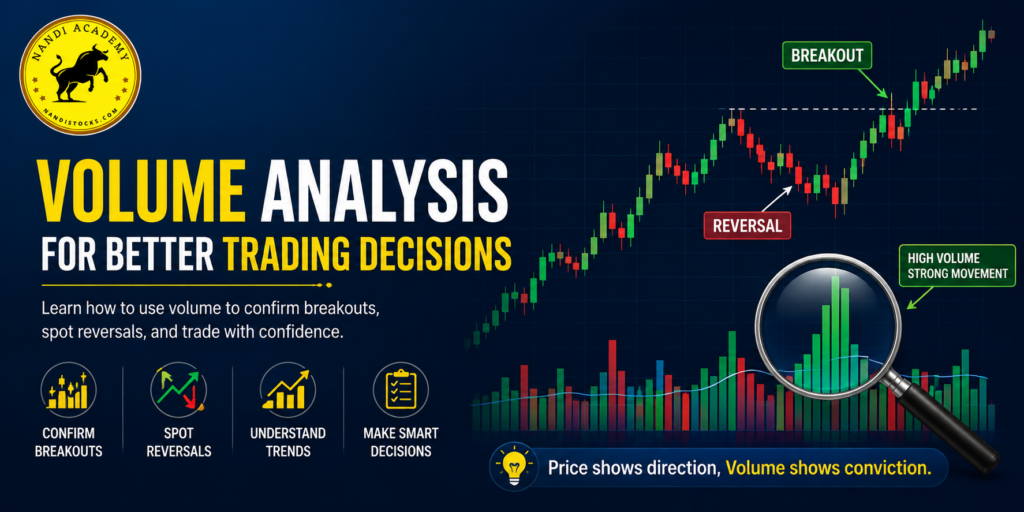
Volume Analysis for Better Trading Decisions

How to Use Volume Analysis for Better Trading Decisions

Volume analysis is one of the most useful tools in technical analysis. While price tells traders what a stock is doing, volume provides additional insight into how much participation is behind that price movement. A rise in price accompanied by strong trading volume can indicate increased buying interest, while a price movement on very low volume may suggest weaker participation. By combining volume with price action, support and resistance, and other technical indicators, traders can make more informed decisions. In this guide, we will understand what volume means, why it matters, how to interpret volume with price movements, and how traders can use it to identify potential breakouts and trend reversals. What Is Trading Volume? Trading volume refers to the number of shares or contracts traded during a specific period. For example, if 500,000 shares of a company are exchanged during a trading session, the volume for that session is 500,000 shares. Volume can be displayed at different time intervals, such as: The appropriate timeframe depends on whether you are a scalper, intraday trader, swing trader, or long-term investor. Why Is Volume Important? Price movement alone doesn’t always tell the complete story. Suppose a stock rises by 5%. If the movement occurs with significantly higher-than-average volume, it may indicate strong market participation. On the other hand, if the same 5% increase happens with unusually low volume, traders may want to investigate whether the move has enough participation to sustain itself. Therefore, volume can help traders evaluate the strength and conviction behind price movements. How Does Volume Analysis Work? Volume analysis involves studying the relationship between price and trading volume. Traders generally look for situations where volume confirms or contradicts price action. For example: Price ↑ + Volume ↑ = Potentially strong buying interest Price ↓ + Volume ↑ = Potentially strong selling pressure Price ↑ + Volume ↓ = Move may have weaker participation Price ↓ + Volume ↓ = Selling pressure may be weakening These are general observations rather than guaranteed trading signals. Volume should always be considered alongside the broader market context. 1. Use Volume to Confirm Breakouts One of the most popular applications of volume analysis is breakout confirmation. Imagine a stock has been trading between ₹900 and ₹1,000 for several weeks. The ₹1,000 level acts as resistance. If the stock suddenly moves above ₹1,000 with significantly higher-than-average volume, the breakout may have greater credibility than a breakout occurring on very low volume. Example Suppose: The substantial increase in volume indicates that many more market participants were involved in the move. However, traders should still watch whether the price can sustain itself above the breakout level. 2. Identify Weak Breakouts Not every breakout is genuine. Sometimes a stock moves above resistance briefly and then falls back below it. This can create a false breakout. Volume can provide an additional clue. If the price breaks resistance but volume remains unusually weak, traders may become more cautious. For example: Resistance → ₹500 The stock moves to ₹510 but trading volume remains below its normal average. Instead of immediately entering a trade, a trader might wait for: This approach can help reduce impulsive decisions. 3. Understand Volume During Uptrends In a healthy uptrend, traders often look for periods where rising prices are supported by increasing or healthy volume. For example: Price: Higher High → Higher High → Higher High Volume: Strong participation during major upward moves This can suggest that buyers remain interested. However, volume doesn’t need to increase on every single upward candle. Traders should focus on the overall relationship between price and volume. 4. Analyze Volume During Downtrends Volume can also help traders understand downward movements. When a stock falls sharply with unusually high volume, it may indicate significant selling pressure. For example: This combination may indicate strong participation from sellers. However, high volume during a decline doesn’t automatically mean that the stock will continue falling. It could also represent panic selling, institutional activity, or potential accumulation. Context is critical. 5. Use Volume to Spot Potential Reversals Volume can sometimes provide clues when a trend is losing momentum. Suppose a stock has been falling for several weeks. Suddenly, it experiences: This could indicate that substantial buying interest has appeared. Some traders refer to such situations as potential selling climax or accumulation zones. However, one high-volume candle isn’t enough to confirm a reversal. Traders should wait for additional price confirmation. 6. Understand Volume Spikes A volume spike occurs when trading volume suddenly becomes much higher than normal. Volume spikes can happen because of: A volume spike becomes particularly interesting when it occurs near important technical levels. For example, a stock approaching resistance may experience a significant volume increase. If the stock then breaks resistance and maintains the higher price levels, the volume spike can provide additional confirmation. 7. Compare Current Volume With Average Volume Looking at volume alone isn’t always useful. A better approach is to compare current volume with average volume. For example: A stock normally trades 200,000 shares per day. Today it trades 800,000 shares. The current volume is approximately four times its normal level. This makes the volume more significant than simply saying that 800,000 shares were traded. Relative Volume Traders often use Relative Volume (RVOL) to compare current trading activity with typical volume. A higher RVOL may indicate unusually strong market activity. However, the interpretation depends on the stock, timeframe, and market conditions. 8. Volume and Support Levels Volume can also be useful around support zones. Suppose a stock has repeatedly found support around ₹750. The stock falls toward ₹750 and suddenly experiences: This combination may suggest that buyers are defending the level. Traders may then watch for confirmation before considering a potential trade. The important point is that volume should support the price action rather than replace it. 9. Volume and Resistance Levels The same concept applies to resistance. Suppose ₹1,200 has acted as resistance several times. If the stock approaches ₹1,200 with increasing volume and eventually closes above it, traders may view

How to Use Volume Analysis for Better Trading Decisions Read More »

Want to grow your money smartly?

🚀 Learn Trading | 📊 Master Stock Market Skills | 💡 Get Expert Mentorship