
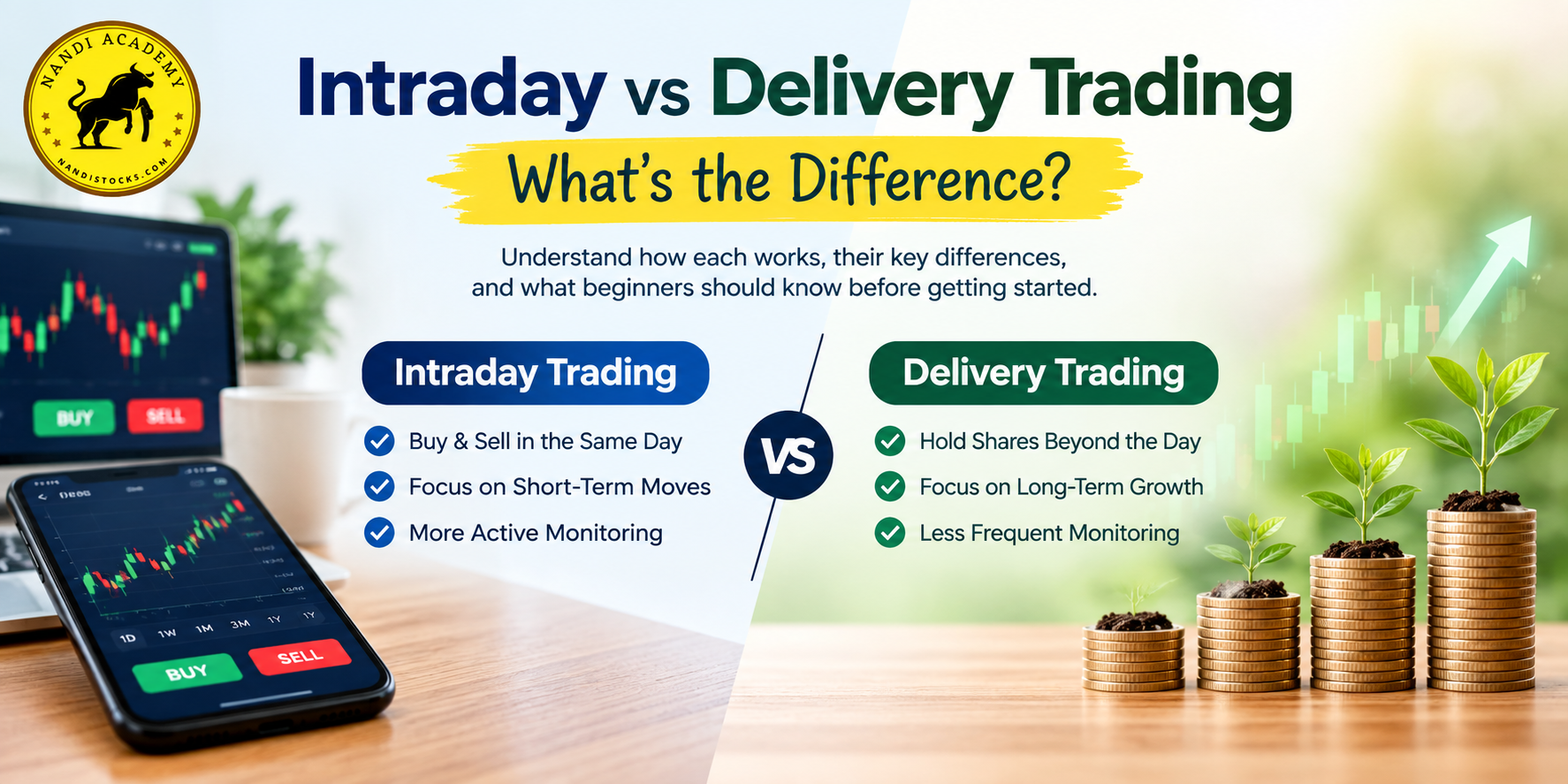
If you are new to the stock market, you may come across terms like intraday trading and delivery trading. While both involve buying and selling shares, the main difference is how long you hold the stocks and how the trade is settled.
Understanding the difference between intraday and delivery trading can help beginners choose an approach that matches their trading or investment goals.
In this guide, we will explain intraday vs delivery trading, how each works, their key differences, and what beginners should know before getting started.
What Is Intraday Trading?
Intraday trading means buying and selling stocks within the same trading day. The trader generally does not intend to hold the shares overnight.
For example, suppose you buy 100 shares of a company at ₹500 in the morning and sell them at ₹510 later that day. The trade is completed on the same day, and the price difference determines the profit or loss before applicable charges and taxes.
Intraday traders generally focus on short-term price movements and may use technical analysis, charts, market trends, and trading volumes to make decisions.
Key Features of Intraday Trading
- Positions are generally opened and closed on the same trading day.
- The focus is on short-term price movements.
- Traders may use technical analysis to identify potential opportunities.
- Brokerage, taxes and other applicable charges affect returns.
- Market movements can be rapid, creating both opportunities and risks.
What Is Delivery Trading?
Delivery trading involves buying shares and holding them beyond the trading day. The shares are delivered to the investor’s demat account after settlement and can generally be held for days, months, or even years.
For example, if you purchase 50 shares of a company and decide to hold them for two years, that would generally be considered delivery-based investing.
Delivery trading is often used by investors who are interested in longer-term price appreciation and, where applicable, other benefits associated with owning shares, such as dividends.
Key Features of Delivery Trading
- Shares can be held beyond the trading day.
- Investors can hold stocks for weeks, months or years.
- The approach is generally more focused on longer-term objectives.
- Investors may consider company fundamentals along with market conditions.
- Short-term price fluctuations may be less important to a long-term investor.
Intraday vs Delivery Trading: Key Differences
| Feature | Intraday Trading | Delivery Trading |
| Holding period | Usually within the same trading day | More than one trading day |
| Main focus | Short-term price movements | Longer-term investment |
| Ownership | Positions are generally closed before the trading day ends | Shares are held in the demat account |
| Analysis | Often technical analysis and price action | Often fundamental and technical analysis |
| Time commitment | Usually requires closer market monitoring | Can require less frequent monitoring |
| Market exposure | Short-term | Potentially longer-term |
| Objective | Seek short-term trading opportunities | Build wealth or gain from longer-term price movements |
| Risk | Short-term volatility can be significant | Prices can fluctuate over longer periods |
Intraday vs Delivery: Which Is More Suitable?
There is no single approach that is suitable for every investor. The choice depends on factors such as your financial goals, time availability, risk tolerance, market knowledge and investment horizon.
Intraday trading may appeal to individuals interested in actively monitoring the market and making short-term trades.
Delivery-based investing may be more relevant to individuals who want to hold shares for a longer period and focus on the underlying company’s business and growth prospects.
Before choosing either approach, it is important to understand how the strategy works and the risks involved.
Advantages of Intraday Trading
Intraday trading has several characteristics that attract active traders.
Short-Term Trading
Trades are generally completed within the same trading session, so positions are not intended to remain open overnight.
Active Market Participation
Traders can attempt to take advantage of short-term movements in stock prices.
Potential Use of Margin
Depending on the broker, product and applicable rules, certain intraday trades may have different margin requirements. However, margin can increase both potential gains and losses.
Advantages of Delivery Trading
Delivery-based investing can be useful for people who prefer a longer investment horizon.
Longer Holding Period
Investors can hold shares through different market cycles rather than closing positions on the same day.
Focus on Company Fundamentals
Long-term investors may examine factors such as revenue, profits, debt, business model, management and future growth prospects.
Potential for Long-Term Growth
If the underlying company performs well over time, an investor may benefit from an increase in its share price. However, returns are never guaranteed, and share prices can also decline.
Risks of Intraday Trading
Intraday trading can involve significant risks because stock prices can change quickly.
A small price movement against a position can result in a loss. Frequent trading can also increase transaction costs. Using leverage or margin can increase the size of potential losses.
Market news, volatility and unexpected price movements can also affect intraday positions.
Risks of Delivery Trading
Delivery trading does not eliminate risk.
A stock held for several months or years can decline substantially because of poor company performance, economic conditions, industry changes or broader market movements.
Holding a stock for a longer period does not guarantee a profit. Investors should research a company carefully and consider diversification and their individual financial circumstances.
Intraday vs Delivery Trading: Example
Suppose the share price of a company is ₹1,000.
Intraday Example
You buy 10 shares at ₹1,000 and sell them on the same trading day at ₹1,020.
Your gross price difference would be:
₹20 × 10 = ₹200
Applicable brokerage, taxes and other charges would affect the actual result.
Delivery Example
You buy 10 shares at ₹1,000 and hold them for two years.
If the share price later reaches ₹1,300, the price appreciation would be:
₹300 × 10 = ₹3,000
Again, this is only an illustration. Actual returns depend on the purchase and sale prices, corporate actions, charges, taxes and other factors.
Can You Convert Intraday to Delivery?
Depending on the broker and the specific order/product, a position may be eligible for conversion from intraday to delivery if the required conditions are met.
However, conversion rules, margin requirements and applicable charges can vary between brokers. Investors should check their broker’s current terms before placing or converting an order.
Intraday vs Delivery: Which One Should Beginners Understand First?
Beginners should first understand how the stock market works, how orders are placed, how profits and losses are calculated, and what charges apply.
It is also important to understand that intraday trading is not simply a faster version of investing. The decision-making process, risk management and time commitment can be different.
Similarly, delivery investing should not be viewed as risk-free simply because shares are held for a longer period.
Learning the basics before committing significant capital can help investors make more informed decisions.
Final Thoughts
The main difference between intraday and delivery trading is the holding period.
With intraday trading, positions are generally opened and closed during the same trading session. With delivery trading, investors hold shares beyond the trading day and can keep them for a much longer period.
Understanding this difference is an important first step for anyone learning about the stock market. Before trading or investing, consider your goals, risk tolerance, time commitment and level of market knowledge.
If you are new to stock market trading, learning concepts such as equity, futures, options, technical analysis and risk management can help you build a stronger foundation.
Frequently Asked Questions
Is intraday better than delivery trading?
Intraday and delivery trading serve different purposes. Intraday focuses on short-term trades, while delivery involves holding shares beyond the trading day. The appropriate approach depends on an individual’s goals, risk tolerance, knowledge and investment horizon.
What is the main difference between intraday and delivery?
The main difference is the holding period. Intraday positions are generally closed within the same trading day, whereas delivery shares can be held for multiple days, months or years.
Is delivery trading safer than intraday trading?
Delivery trading is not automatically safer. Both approaches involve market risk. Intraday trading can be exposed to short-term volatility, while delivery investments can experience losses if the value of the shares declines over a longer period.
Can I hold an intraday trade overnight?
Intraday positions are generally intended to be closed before the trading session ends. If a position is intended to be held overnight, it may need to be placed under an appropriate delivery or other product type, depending on the broker and the security.
Can beginners do intraday trading?
Beginners can learn about intraday trading, but they should understand the risks, trading costs, order types and risk-management principles before committing capital. Short-term price movements can result in losses quickly.
Do I need a demat account for delivery trading?
In India, delivery-based equity investing generally involves holding securities electronically in a demat account. The exact account and settlement requirements depend on the type of security and transaction.
Which has a longer holding period: intraday or delivery?
Delivery trading has the longer holding period. Intraday trades are generally completed within the same trading day, while delivery positions can be held for an extended period.