
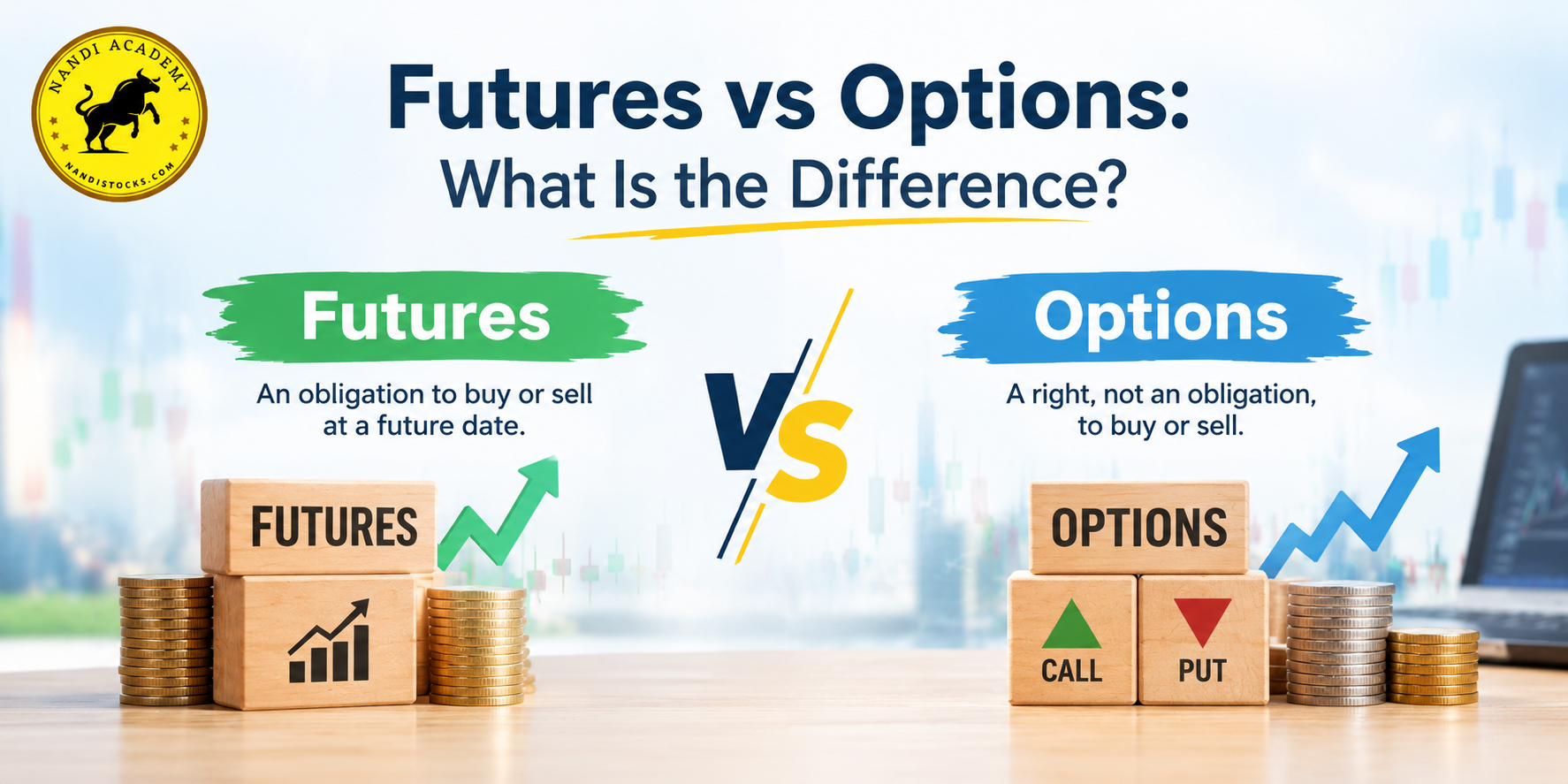
Futures and options are two popular types of derivatives used in the stock market. Both allow traders and investors to take positions based on the future movement of an underlying asset such as stocks, indices, commodities, or currencies. However, they work differently and involve different levels of risk, cost, and obligation.
Understanding the difference between futures and options is important before entering the derivatives market. This guide explains futures vs options in simple terms and highlights how they differ in terms of obligation, risk, investment, profit potential, and trading strategy.
What Are Futures?
A futures contract is an agreement between two parties to buy or sell an underlying asset at a predetermined price on a specified future date.
When you trade futures, you are taking an obligation to fulfil the contract according to its terms. You do not normally pay the entire value of the underlying position upfront. Instead, a margin is required to take the position.
For example, suppose you expect the price of an index to rise. You can take a long futures position. If the index rises as expected, you may make a profit. However, if it moves against your position, you can also face significant losses.
Futures are commonly used for:
- Short-term trading
- Hedging
- Taking directional positions
- Managing exposure to an underlying asset
What Are Options?
An options contract gives the buyer the right, but not the obligation, to buy or sell an underlying asset at a predetermined price within or at a specified time, depending on the contract type.
There are two main types of options:
- Call Option: Gives the buyer the right to buy the underlying asset.
- Put Option: Gives the buyer the right to sell the underlying asset.
Unlike a futures contract, an option buyer can choose not to exercise the contract if the trade does not move in their favour. The buyer pays a premium for this right.
For example, if you purchase a call option because you expect a stock or index to rise, your potential loss as an option buyer is generally limited to the premium paid, although the exact risk depends on the strategy used.
Futures vs Options: Key Differences
The biggest difference between futures and options is the obligation involved.
| Feature | Futures | Options |
| Contract type | Agreement to buy or sell | Right, but not obligation, for the buyer |
| Obligation | Both parties have obligations | Option buyer has no obligation to exercise |
| Initial cost | Margin is required | Buyer pays a premium |
| Risk | Can be substantial for both long and short positions | Option buyer’s loss is generally limited to premium paid |
| Profit potential | Can be significant depending on price movement | Depends on the option and strategy |
| Time value | Not applicable in the same way as options | Important factor |
| Main types | Futures contracts | Call and Put options |
| Complexity | Relatively straightforward | Can be more complex |
| Common uses | Trading and hedging | Hedging, income strategies and directional trading |
Futures vs Options: How Risk Works
Risk is one of the most important factors to understand before trading derivatives.
With futures, both profits and losses can increase as the underlying asset moves. For example, if you take a long futures position and the underlying price falls significantly, your losses can increase accordingly.
Options work differently. If you buy an option, the maximum loss is generally the premium paid for that option, assuming you hold only that long option position. However, option sellers can face substantially higher risks, depending on the position and whether it is hedged.
This is why traders should understand position sizing, stop-loss strategies, margin requirements and risk management before trading derivatives.
Futures vs Options: Which Requires More Capital?
The capital requirement depends on the contract, broker, market conditions and trading strategy.
A futures trader generally needs to maintain the required margin to hold a position. Although the trader does not pay the entire contract value upfront, the position can have significant exposure to the underlying asset.
An option buyer pays a premium to purchase the option. The premium can be considerably lower than the total value of the underlying asset, but it can also lose value quickly because of factors such as time decay and changes in implied volatility.
Therefore, a lower upfront cost does not automatically mean that options are easier or safer to trade.
Futures vs Options: Profit Potential
Both futures and options can provide opportunities to profit from market movements, but the way profits are generated is different.
In a futures trade, the profit or loss generally changes directly with the movement of the underlying asset, based on the contract specifications.
For an option buyer, the underlying asset needs to move sufficiently in the expected direction to overcome the premium paid and other factors affecting the option’s value.
Options can also be used to construct different strategies involving calls and puts. These strategies can be designed for bullish, bearish, neutral or hedging purposes.
When Should You Consider Futures?
Futures may be suitable for traders who:
- Understand margin and leverage
- Have a clear trading strategy
- Can manage significant price fluctuations
- Understand the risks of leveraged positions
- Want direct exposure to the movement of an underlying asset
However, futures are not automatically suitable for beginners. Leverage can increase both potential gains and potential losses.
When Should You Consider Options?
Options may be useful for traders and investors who understand how premiums, expiry, volatility and time decay work.
Options can be used for:
- Hedging an existing portfolio
- Taking bullish or bearish positions
- Creating defined-risk strategies
- Generating income through certain strategies
- Managing exposure during uncertain market conditions
However, options trading can become complex quickly, particularly when multiple contracts are combined into a strategy.
Futures vs Options: Which Is Better?
There is no single answer to whether futures or options are better.
The right choice depends on your objective, risk tolerance, market view, capital, experience and trading strategy.
Futures may be more suitable when you want direct exposure to price movements and understand margin-based trading.
Options may be more suitable when you want flexibility or want to use strategies where risk can be defined, particularly for option buyers.
The important point is not to choose a derivative simply because it requires less initial capital. You should understand how the contract works and what can happen if the market moves against your position.
Futures vs Options for Beginners
Beginners should first understand the basics of the stock market before moving into derivatives.
Before trading futures or options, learn about:
- Market orders and limit orders
- Margin requirements
- Leverage
- Stop-loss
- Contract size
- Expiry dates
- Option premiums
- Time decay
- Implied volatility
- Risk management
- Trading psychology
A strong understanding of these concepts can help traders make more informed decisions and avoid taking excessive risks.
Final Thoughts
Futures and options are powerful financial instruments, but they work in very different ways. Futures involve an obligation under the contract, while an option gives the buyer a right without the obligation to exercise it.
Futures can provide direct exposure to market movements, while options offer greater flexibility and can be used for various trading and hedging strategies. At the same time, both require a proper understanding of risk and market behaviour.
If you are planning to enter the derivatives market, focus on learning the fundamentals first and develop a clear risk-management approach before trading with real money.